Category Archives: Books

Books

“A Complete Unknown”: Jorge Luis Borges, Shakespeare, and Bob Dylan

Monday, January 30, 2024

Even before I decided to watch the Bob Dylan biopic yesterday afternoon, one of my first thoughts was, “I wonder if Bob Dylan has seen the film, and if so, what does he think of it.” After seeing the film, I wondered not so much about what Dylan might have thought of how he was portrayed, but of how he assessed the portrayal of Suze Rotolo, with whom he had his first intense love affair in New York City. I would urge anyone who has seen the film and is not familiar with her life to first read her obituary in the New York Times and then to read her own memoir of that period.

https://www.nytimes.com/2011/03/01/arts/music/01rotolo.html

One of the things that bothered me about the film is how it focused completely on the music in the city, as if somehow that is what made NYC such a magnet for artists back then. As the obituary points out, Suze Rotolo introduced Dylan to other artistic scenes in New York that were being reviewed in the Village Voice. For that matter, where is the Village Voice newspaper in this film? A review that appeared in the New York Times is quoted as Dylan and his manager are in an elevator, but the newspaper that young people were reading in NYC was the Village Voice.

To underline my question of why an issue of VW is not at least seen in the apartment in NYC in 1962, let us remember that the final print issue of the Village Voice (September 20, 2017) used a photograph of Bob Dylan as its cover image. It’s hard to read Chad Byrnes’s review in the on-line successor to the Village Voice without thinking of this overlooked detail in the film, just as the film lacks any genuine sense of NYC’s weather in the early 1960s. The winters were especially brutal back then, though that may not have bothered a young man from the upper regions of Minnesota quite as much.

Review: ‘A Complete Unknown’ Follows Bob Dylan’s 1960s  Journey From the Village to Newport

What else would I have liked to have seen in A COMPLETE UNKNOWN? It would have been interesting, I think, to have had a scene in which a look-alike of Frank O’ara and Bob Dylan had walked past each other on the street, neither of them glancing at the other, let alone recognizing the other.

Dylan’s brash disdain for other’s expectations culminates in his confrontation with the folk audience at the Newport Festival in 1965. The context could have used some amplification. The “folk-rock” movement was already well underway The Byrds, a Los Angeles-based band, had recorded “Mr. Tambourine Man” in January, 1965, and their version of the song was released to great success in April. By the time Dylan took the stage, what else would the audience have expected? For that matter, what would have worked a lot better in the film would have been the confrontation in the motel before the concert to have had Dylan playing listening to that single being played on the radio. Better still, in fact, why not have the soundtrack be the following: the last 15 seconds of “(I Can’t Get No) Satisfaction” with a half-second pause followed by the Byrds’s version of “MR. Tambourine Man,” which slowly fades into the background as the argument over Dylan’s choice of material for the Newport concert escalates. The music was changing faster than the times.

If Robert Zimmerman remains a “complete unknown” in this film, it would only surprise those who have not read Jorge Luis Borges’s “Everything and Nothing,” his concise portrait of William Shakespeare, who is capable of imagining the enormous, almost innumerable, permutations that human consciousness can experience, and yet these portrayals can only come into existence because Shakespeare himself was empty: his identity was “nothing,” and therefore could be inhabited by whatever configuration presented itself. Dylan was and is no different. “I don’t believe in Zimmerman,” sang John Lennon. Join the club, John. Neither did Bob Dylan. It is only the words of the songs that deserve to be believed, and relived in our inner dailiness.

Finally, there is one song that Dylan recorded that the film missed a major chance on using to bring the film to a boiling point. A COMPLETE UNKNOWN should have cut to the studio in NYC with the note: “Four days later,” and had Dylan recording “Positively Fourth Street.” It’s possible that Dylan is not thinking of the audience at Newport when he sings the lines:

You see me on the street
You always act surprised
You say “How are you? Good luck!”
But you don’t mean it
When you know as well as me
You’d rather see me paralyzed
Why don’t you just come out once
And scream it

And who could blame Dylan for his sardonic candor? The audience at Newport had obviously not listened to the aphorism in “It’s All Right, Ma (I’m Only Bleeding)”: “He not busy being born is busy dying.” Indeed, the audience at Newport would rather have seen him artistically paralyzed as a folk singer rather than have him develop into a writer whose song lyrics can stand on the page as a poem. Speaking of which, by the way, where is any mention in the film of Bob Dylan’s first appearance in a poetry anthology. Walter Lowenfels included Dylan in POETS OF TODAY, which was published in 1964. It included some of the most important poets of that period, and was unusual for its time in both the number of African-American poets it included as well as poets based on the West Coast. It should be added that it was published by the publishing arm of the U.S.A. Communist Party.

******

For an overview of films about Dylan or films in which he plays a character, see:

https://www.nytimes.com/2024/12/29/movies/bob-dylan-movies.html

Books

West Coast Poetry Anthologies and the “Anthology Wars”

Steve Axelrod and Craig Svnokin edited one of the most well-balanced surveys of contemporary American poetry in a volume entitled THE BLOOMSBURY HANDBOOK TO CONTEMPOARY AMERICAN POETRY. This book is huge and does not come cheaply, so it would be best to have your local or campus library order it. It is not just another collection of essays, however. It contains a substantial number of interviews with some of the best-known working poets.

“The most intriguing chapters in “Roots and Branches,” aim to rewrite liter- ary history retrospectively. ,,,,,, Bill Mohr, in “The National Anthology Wars and West Coast Anthologies,” challenges the by-now conventional narrative of “anthology wars” as a path through which mid- and late twentieth-century anthologies (and the poets they represent) came to be canonized. As one of the few chapters in the Handbook to examine where (and why) poets get published, and also the role MFA programs play in canon craft- ing and the professionalization of poetry, Mohr raises crucial questions about editing criteria, especially for mainstream East Coast anthologies, such as The Morrow Anthology of Younger American Poets (1985), which, he argues, unlike the radical, small press West Coast anthologies he champions, “shimmered with identity flourishes, as it coordinated the personal characteristics of its poets in a manner that clearly emphasized class and cultural capital,” with back-cover copy trumpeting “the poets’ identities, revealing them as implicitly middle- to upper-class (‘suburban parents,’ ‘one or more graduate degrees in literature and writing,’) and heteronormative” (157). In contrast, West Coast anthologies, such as Ron Silliman’s In the American Tree, Mohr’s own Poetry Loves Poetry, and Philip Levine and Juan Felipe Herrera’s Down at the Depot:20 Fresno Poets, along with Bay Area anthologies representing Berkeley and San Francisco Renaissance poets, were much more diverse (in terms of ethnicity, sexuality, and poetic form), and therefore more accurate harbingers of twenty-first-century-US poetry today than doorstopper, “career-making” collections like the Morrow Anthology.

Concluding his essay, Mohr lauds West Coast anthologies for their anti-institutionalist stance, which is, ironically, one exception to the otherwise forward-looking perspective that made them forerunners of poetry today.”

The Bloomsbury Handbook of Contemporary American Poetry ed.by Craig Svonkin and Steven Gould Axelrod
REVIEWED BY MEG SCHOERKE

Pacific Coast Philology, Volume 57, Issue 2, 2024, pp. 203-209 (Review)
Published by Penn State University Press

Books

South Rose Park: Gusto, PATM, and Harley Lond’s Ocean Park

Friday, December 27, 2024

Back when I was the editor and publisher of Momentum Press, I lived in Ocean Park, the southern most section of Santa Monica. It was “south of Pico,” to use a phrase that eventually became the title of a book about art galleries run by and for people who didn’t fit into the “white” world north of Pico Blvd. Ocean Park did not have the aura o “hipness” that Venice possessed, but since the two areas were contiguous, it was not that surprising that they turned out to be culturally and politically aligned in the three decades following World War II. One particular enterprise shared a recognizable boundary line between Venice and Ocean Park when I lived there: the Pioneer Bakery, on Rose Avenue. It was known as the place to go for the best and most affordable day-old sourdough bread.

While teaching at CSU Long Beach for the past 18 years, I have lived in the South Rose Park area of Long Beach, which in certain ways reminds me of Ocean Park. It, too, features a bakery, called GUSTO. Linda and I have the good fortune to live only three blocks away from it and have enjoyed its breads and specialties since it first opened. Its distinctiveness has not gone unnoticed. The New York Times recently did a national survey of noteworthy bakeries and Gusto made its list of the top 22.

Adjacent to GUSTO is a bookstore that is heir to the tradition of political print culture outlets in Los Angeles County. In the last century, stores such as Papa Bach and Midnight Special contributed to the legacy that PAGE AGAINST THE MACHINE is now the latest member of. PATM is a combination of a carefully curated used book store and the most current and relevant books to the ongoing global crisis of displaced refugees and the ecological suicide of the planet’s supposedly most intelligent inhabitants.

A few blocks west of Gusto and PATM is the Art Theater, which is the only stand-alone movie theater left in Long Beach. If Venice and Ocean Park has the Fox Venice theater, then South Rose Park can counter with the Art Theater, which is currently showing “A Complete Unknown,” to be followed by “The Apprentice.” This is not a neighborhood where MAGA has much traction.

One of the big differences between Ocean Park and South Rose Park is that Jim Conn, the minister and congregation of the United Methodist Church at the former back in the 1970s and 1980s, was prominently active in left-wing political causes to a degree unmatched by many contemporary ministers. While each branch of the current United Methodist churches in Ocean Park and South Rose Park would feel at complete ease in their shared theological and progressive sociological tenets, the Church in Ocean Park also distinguished itself as a cultural center for the neighborhood in the 1970s and 1980s.

Ocean Park no longer has any meaningful rent control at work, and the neighborhood has largely been gentrified. Real estate prices have made home ownership impossible in this neighborhood for anyone who currently lives here and doesn’t own a house. It’s doubtful that this neighborhood will sustain its current ambiance for more than another 16 years, but since I’m unlikely to live much longer than a fraction of that time, it looks as if I’ll be lucky enough to have lived in two of the most accommodating neighborhoods that Southern California could have offered in my lifetime. It’s been a hard life, but not without its blessings.


(The sign perched over Lincoln Blvd. is all that’s left of the Fox Movie Theater.)

For those who might wonder if this nostalgia about Ocean Park is merely one individual’s subjective recollection, I have received permission from Harley Lond, an old friend and artistic collaborator who also lived in Ocean Park over fifty years ago, to reprint his description of the neighborhood.

“I lived in Ocean park for a couple of years (1967-1969), first at Pine
west of Lincoln, then around the corner from you at 4th and Hill
(actually off an alley). Rents were cheap; people were great. And the
dive bars and restaurants along Pacific and Main were great (even the
college hot spot The Oar House) – and nearby restaurants – there was the
Rose Cafe on Rose just west of Lincoln; and a great home-cookin’ joint at
Ocean Park and Pacific run by a black woman who made the greatest
breakfasts in the world. Artists, writers, bohemians, hippies.” — Harley Lond, 1//1/2025

*******

Happy New Year! May 2025 be unexpectedly prosperous in the imaginative sense of that word.

https://www.nytimes.com/article/best-bakeries-america.html
22 of the Best Bakeries Across the U.S. Right Now
In this golden age of American bakeries, virtuosic pastries and delightful breads are close at hand, from coastal Maine to downtown Los Angeles.
Dec. 24, 2024

Gusto Bread
Long Beach, Calif.
Cody James for The New York Times
If it’s hard to imagine an improvement on the kouign-amann — that perfectly caramelized helix of salted butter and dough from Brittany — then it’s time to try the Nixtamal Queen, completely transformed by an addition of sourdough and nixtamalized corn. It’s just one taste of what Gusto can do. Informed by Mexican and Indigenous traditions, Arturo Enciso and Ana Belén Salatino, above, run a neighborhood panadería with an expressive, unconventional and highly delicious approach that extends to conchas, multigrain breads and all kinds of seasonal pastries that make the bakery a destination. TEJAL RAO
2710 East 4th Street, Long Beach, Calif.; 562-343-1881; gustobread.com

Books

Canada/Baja Canada: The New Kid on the Continental Block

Erstwhile, U.S.A., Inc.

So apparently P-E-T trotted out the old joke about annexing Canada when he met with Prime Minister Trudeau recently.

It got me to thinking: why not reverse things and allow Canada to annex all the states that don’t care for Trump?

Just as Mexico has a peninsula named Baja California, why not allow Washington, Oregon, and California to be “Baja Canada”?

In this new arrangement, I would propose that the eastern half of Oregon be allowed to join the state of Idaho, and northeast county of Modoc in California could join in the exodus, too.

If Maine, Massachusetts, and New York want to form an East Coast affiliate, that would make life for MAGA nice and homogenous in terms of political power

As part of the art of this deal, of course, the MAGAUSA takes responsibility for the entire national debt of the United Sates, and they are more than welcome to do away wit any debt limit. Good luck, my fellow erstwhile citizens.

But that is not the major sticking point I foresee. Instead, I imagine this would require a constitutional convention. Given the lack of people of color and women at the drawing up and ratification of the original constitution, it would only be fair play for no white males to be allowed to participate in the drawing up of the new constitution. I have a gut feeling that this arrangement would not sit well with Clarence Thomas, even if he were a ex officio member of the committee that organized elections of the convention’s membership. After all, he would be outnumbered by the Supreme Court judges who are women.

Books

“THE SHINING” by Stephen King (Notes on a Novel); or “Redrum Redux”

Saturday, December 14, 2024

The Syrian dictator Assad has been forced to run for his life and is now in Moscow. It is unclear how many, if any, of his closest associates were permitted to avail themselves of a “Humanitarian exception” and sneak into the kennel of exile along with Assad. Putin knows perfectly well the horrors that Assad had his henchmen perpetuate in the prison at Sednaya. At least 30,000 people were tortured and murdered in a manner that can only leave any thoughtful person reluctant to believe that human dignity actually exists as anything other than a necessary fiction incapable of defending itself against the avariciousness of evil. Evil as a mental virus feeds on human consciousness, and there is no antidote or vaccine.

https://www.aljazeera.com/news/liveblog/2024/12/7/syria-war-live-news-govt-says-president-al-assad-has-not-fled-damascus?update=3370892&gsid=564ff7be-3c6b-495c-935e-52927fb4e397

***

“A crisis is a terrible thing to waste,” the saying goes. Israel has wasted no time in expanding its war of debilitation in the region. Gaza: check. Iran: check. Syria: check. Does any serious threat to Israel’s continued existence actually exist at this point? The major question, in fact, is how well is Israel prepared to deal with its success? The people of Israel probably have no more idea of how to take best advantage of the sudden disarray and disminishment of their enemies than the rebels in Syria are truly prepared to reinvigorate a nation ravaged by a merciless dictator.

Meanwhile, the war in Ukraine continues to inflict an unfathomable amount of sorrow on all those being skewered by the nationalist ambitions of a Russian billionaire for whom the word dictator is too mild an accolade.

Given the current horror show — the truly Grand Guignol — of current events, it’s understandable that some people might just want to crawl into bed and read a book that they first read back when they were young and one could indulge in some “escape fiction” with only a moderate amount of shame for turning one’s head away from the slaughterhouse on the other side of the world.

For those so inclined — and I do not fault you at all — here are some notes I dug up from long ago tat I jutted down about “The Shining.”

****

THE SHINING – “Redrum” Redux

“the Shining” by Stephen King
Signet Books, New American Library – Times Mirror (paperback, 1978)

The climax of the book made me remember the original nurder/suicide of Gray, the alcoholic caretaker Since there was no mention of putting in a new furnace, why didn’t it blow up when Grady murdered his family and himself? Did the ranger arrive an hou after it happened? That’s damn had to believe! So the hotel should have blown up with Grady’s death.

Later on, after Wendy asks Jack if anything happened in 216 when Jack went up to check the room, and then asks him a second time, it’s obvious that she doubts him. At that point, it would only make sense for her to go up and check. How much better it would have been if she had gone up to check, had gotten trapped in the room, gone raving ma; then Jack and Danny would have to look for her and they would hear sounds coming from the place. They would have to decide to go in there and rescue her. Danny and Jack would have a serious confrontation what they had seen in there, and a question of the father’s courage forms in Dany’s mind, and they finally go in there.

Perhaps combining certain sequences where Danny has to fun down and get a passkey and the fire hydrant hose then writhes at him. On the whole, there is too much one on one in this story.

The hedge animals are used very well. Jack, Danny, and Halloran all confront the hedge animals. Once again, though, Wedny does’t confront them. It’s as theought she is kept of out of the story – she doesn’t confront room 216 and she doesn’t confront the hedge animals. The whole story falters because of this.

The wasp thing appeared to be only a one-time incident, but the lock on the attic trapdoor which Hack had put there after the wasp incidenct comes back beautifully a the climactic scenes.

The woman in 217 should have been involved in the climax in some way. What if Wendy and she had had a direct confrontation. Or at least if all these people were waiting down by the furnace when Jack is down there just before it blows up – the part should have going full-force there.

What stands out about these notes is how I am emphasizing the diminishment of Wendy as a leading character in the story. She is certainly not reduced to cameo status, but one does not have the sense in the story that King sat there and ran the story line through her eyes. How would the entire story be seen through her subjectivity? My emphasis on women writers in my publishing project, therefore, was aligned with how I saw women presented as active agents in lthe culture at large.

**********

As a postscript, I believe these notes were written back when Craig Bolotin was my roommate in the two-bedroom apartment I lived in on Hill Street in Ocean Park. The notes probably reflect the kind of conversations we had about story structure back then.

Books

CEO Lives Matter! (or Where’s the Outrage Now?)

Brian Thompson, R.I.P.

The outpourings of public grief are very impressive. It would be hard to top the vigils at the Dakota after John Lennon’s murder forty-four years ago this December 8, but New Yokers are apparently going all out in pausing in their busy lives to honor the late Brian Thompson.

One visitor from Southern California is quoted as saying, “I haven’s seen so many spontaneous roadside memorials since I drove through Little Saigon in Westminster, Garden Grove, and Santa Ana just after Lt. Calley’s death was announced.”

https://www.propublica.org/article/unitedhealth-mental-health-care-denied-illegal-algorithm?utm_source=sailthru&utm_medium=email&utm_campaign=majorinvestigations&utm_content=feature
“(UHC) is one of the ten most profitable companies in the world. …..While the massive insurer — one of the 10 most profitable companies in the world — offers plans to (40 million) people (throughout the entire U.S.A.), it answers to no single regulator.”

********

New York Times: “Torrent of Hate for the Health Insurance Industry”

https://www.yahoo.com/news/americans-little-sympathy-murdered-health-223930677.html
https://www.nytimes.com/2024/12/05/nyregion/social-media-insurance-industry-brian-thompson.html

The Guardian:
https://www.theguardian.com/commentisfree/2024/dec/07/brian-thompson-unitedhealthcare

Wait a minute. Wait a minute. Wait just a freak-flag moment!!!! Why is there much a vociferous lack of compassion for a fellow American who is no different than a professional athlete or a professional politician- just another guy trying to make a good living and provide for his family? Mr. Thompson had a wife and two children. What part of their sorrow do you not understand?

First of all, the health care Americans were provided before 2016 was fairly mediocre. But as I’m sure you remember, Donald Trump promised that we as a nation would have “fantastic” and “beautiful” health care if we elected him president. And he fulfilled that promise, as far as I can see. I’m not sure why he talked about “the concept of a plan” in the 2024 campaign debate with Kamala Harris, since our health care system is “fantastic” and “beautiful” after he got to work in his first term.

And new that he is returning to the White House for another four years, why don’t people realize that whatever new plan he has will be even more fantastic and beautiful. Over 70 million people voted for him, so I assume their health care is nothing short of incredible.

So, in the absence of any public comment by both President-Elect Trump and President Biden, please join with me in chanting: “CEO Lives Matter!” “CEO Lives Matter!”

****

But before we protest this senseless murder of a hard-working CEO, let’s review some recent history.

Within days after a police officer in Minneapolis publicly knelt on George Floyd’s neck long enough to cause his death, protests broke out across the United States. “Black Lives Matter” roiled social discourse to such an extent that President Trump considered taking extreme measures to quell the outrage that tens of millions of people felt, not just about Floyd’s execution but the long, often repressed history of police brutality.

In contrast, following the assassination of UnitedHealth CEO Brian Thompson, I have not heard of a single public demonstration that rebukes this action. Where is the outrage now? Is a CEO’s life any less valuable than George Floyd’s? Americans should be flooding the streets demanding congressional action now to make sure this kind of tragedy never happens again. Instead, they remain silent, or worse still, get snarky, and in doing so, are complicit in the assassination.

Let’s be clear about this: the assassin’s real target was the profit-making system of health care in this country. Those of us who believe that profits are more important than people need to speak up now; otherwise, the assassin’s attempt to intimidate corporations from the perfectly legal ways they conduct business will result in the collapse of the health care economy, which is the most prosperous in the world!

Unfortunately, there is a disinformation campaign going on tn the United States that claims health insurance companies engage in what is termed “delay and deny.” What is needed is not less “delay and deny” but even more “delay and deny.” People who enroll in these insurance policies need to understand that they are nothing more than a herd of cows being nurtured until it’s time to pass through the slaughterhouse of hospice care. The food industry model is the template upon which health care shapes its policies.

CEOs Lives Matter! Be the first one in your community to make a sign and stand at a freeway entrance or major intersection! Be willing to block traffic and get arrested. If you don’t protest, you are indeed expressing your approval of the agenda of the assassin of UHC’s CEO.

Footnote: Should anyone think my invocation of “profit” is off-the-mark, I would like to cite this recent article in The New Yorker/

https://www.newyorker.com/news/the-lede/what-the-murder-of-the-unitedhealthcare-ceo-brian-thompson-means-to-america?utm_source=nl&utm_brand=tny&utm_mailing=TNY_Daily_120724&utm_campaign=aud-dev&utm_medium=email&utm_term=tny_daily_digest&bxid=5bea15dc24c17c6adf1d75ea&cndid=50555100&hasha=7caeec83f7eb1d1e07520665f3b23972&hashb=96cf50f0c09e5a1d79e45f7efc213ce05278e7f8&hashc=37c43a5c3a11da12bdc55f9c622d0baf0ec7493490d9327a7099d22dd53e6a5e&esrc=bounceX&mbid=CRMNYR012019

“Of course, the solution, in the end, can’t be indifference—not indifference to the death of the C.E.O., and not the celebration of it, either. But who’s going to drop their indifference first? At this point, it’s not going to be the people, who have a lifetime of evidence that health-insurance C.E.O.s do not care about their well-being. Can the C.E.O. class drop its indifference to the suffering and death of ordinary people? Is it possible to do so while achieving record quarterly profits for your stakeholders, in perpetuity?”

My answer to the last question in that paragraph is “No.” An emphatic no.

*******

Former Boston police commissioner Ed Davis has weighed in on the public’s apathy about this political assassination:
“I’ve been watching it, and I’ve been shocked by it,” Davis told the Wall Street Journal on Sunday. “It’s actually troubling to see it, and I really am surprised that people are reacting that way considering the tragic loss here and the violence of what happened.”

He added: “It’s a huge problem. People’s lack of sympathy is really troubling. And the problem with that is, the people who have this kind of animosity, simply because of the circumstances may not be prone to help—and the police are really looking for help from the public on this.”

If I could interview Mr. Davis, I would ask him to comment on the difference between “lack of sympathy” and “animosity.” One can lack sympathy for someone else’s plight without feeling animosity.

Definition:
: a strong feeling of dislike or hatred : ill will or resentment tending toward active hostility : an antagonistic attitude.

Mr. Thompson’s assassin felt extreme animosity toward a specific hearth insurance company. The public trolling of Mr. Thompson’s assassination is a reflection of the widespread belief that some health insurance companies treat those they insure with te same callousness with which Thompson’s assassin disposed of him. The only difference is that one execution is carried out in a manner hidden from public disoourse, Mr. Davis.

Hostility means that someone will act in a pugnacious manner. I have not heard of anyone impeding the police search for this murderer. “The police need the public’s help,” is the current plea. “And what would we get in return for that help?” I would ask. Would police refuse to follow orders and not physically attack demonstrators against the injustices of a capitalist system? When the police show they are willing to help those who oppose the deleterious behavior of large corporations, instead of serving as their enforcers, then perhaps the public will give more help in a case such as this one.

*****

Breaking news on Monday, December 9, 2024
An influencer by the name of Michael McWhortle urged his followers to “cooperate with authorities” and perhaps that inspired someone in Altoona, Pennsylvania to contact police when they spotted someone who seemed to be a possible suspect.Apparently, this “person of interest” is alleged to have had a ghost gun, a fake i.d., and a handwritten manifesto denouncing the health care insurance industry. It’s a little hard to believe that someone who planned a murder in considerable detail would have retained the very things that would be most likely to convict him. If tis is true, it goes to show that an “ordinary” individual criminal is no different than a group of government bureaucrats. “What’s the exit strategy?” is the first question anyone should ask before they undertake any task that affects other people’s lives. President Bush, Dick Cheney, and Donald Rumsfeld all failed to ask that question before they manipulated information to justify te invasion of Iraq. Imagine the deaths of thousands of people whose lives were just as important to them as Brian TWompson’s life was to himself and his family, and with that magnification begin to comprehend the confounding amount of sorrow that afflicts people in Iraq. Brian Thompson’s family no doubt is very sad, but the grief that first needs to be acknowledged is not Thompson’s family or cohort of business executives, but the long forestalled apology that the people of the United States owe to the people of Iraq.

For the record, it appears that the name of the “person of interest” alleged to have targeted Urine/You’reinHorricCare Health Insurance CEO Brian Thompson is Luigi Mangione.

Books

Kathi Flood: Interrupted Retrospective Rebound

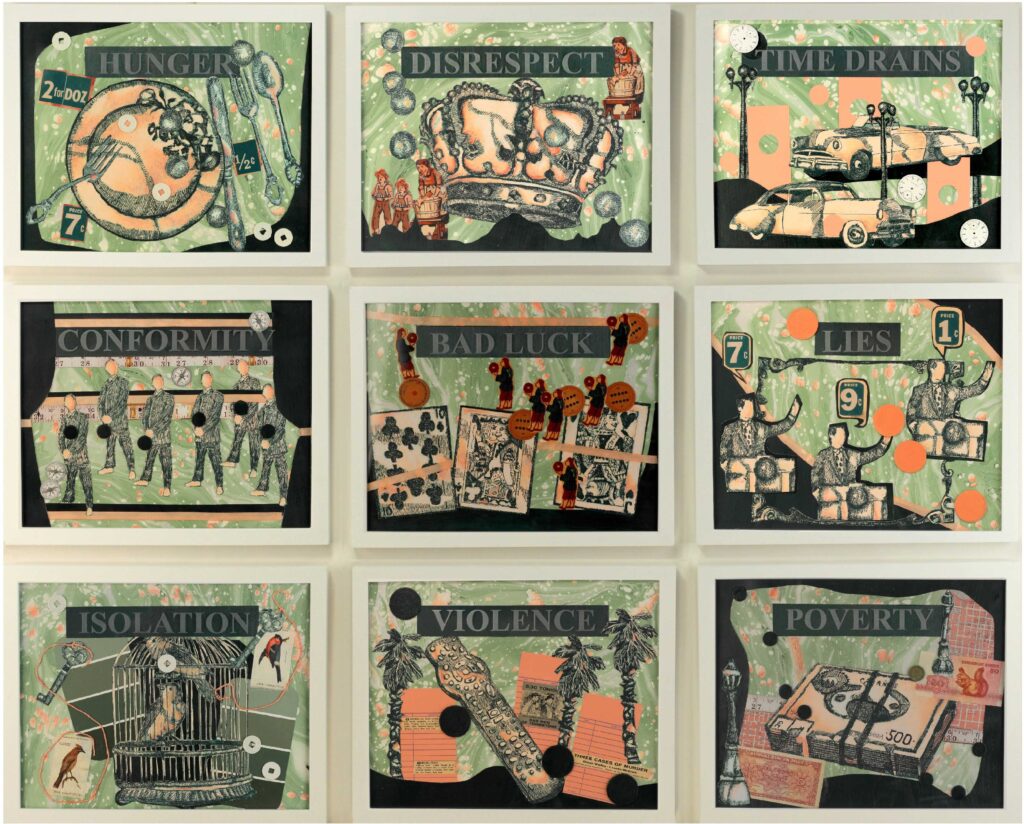
Just as poets will write for several decades and have a volume entitled “New & Selected Poems,” visual artists who have produced an intriguing body of work deserve to have a major retrospective at least once, if not also a second and instance, in their lifetimes. One artist who might well have been granted such concentrated attention is Kathi Flood. A combination of things has worked to forestall such an exhibition, not the least of which was the pandemic. Covid-19, of course, altered the lives of tens of millions of people in the United States in ways that can never be recuperated, so Flood is hardly alone in that dispiriting interruption.

Nevertheless, as artistic social life begins to acclimate itself to the stupendous technological changes of the past quarter-century, it would behoove a major gallery to at the very least make her one of the featured artists of a retrospective of some sort. Among all the activities of human consciousness, art has a singular capacity to defamiliarize the hypnotic allure of the present tense; it’s all too easy to succumb to the whiplash messages of our individual inadequacies when confronted with the indefatigable dismissals of our self-worth. Kathi Flood’s jaunty collages and assemblages create an environment that pulls out of that tailspin and revivifies our internal landscape with the poignancy of our cherished yearnings. How, in fact, do we manage to hold out against the bullying odds of what is construed to be a zero sum game? Resistance involves minor moves, the kind only an adept guerrilla sociologist can bring about.

The Long Beach Museum of Art takes pride in having been part of the first breakout points.of the work associated with the Woman’s Bouse project that led to the establishment of the Woman’s Building in Los Angeles. LBMA would be a perfect venue to present a retrospective of Flood’s work.

ARTIST’S STATEMENT

My work offers colorful narratives about urban life, much of it specific to Los Angeles. I categorize and comment on local issues such as traffic patterns, over-development, qualities that define a city, and the architecture of Los Angeles. I use sociology and psychology to consider contemporary issues such as telemarketers, surveillance, the complexity of modern life, relationships and communication, consumerism and excessive materialism, fashion, the evolution of media, politics, adjusting to the Electronic Age, the quality of our medical care, psychotherapy, the development of language, school cultures, and art marketing in Los Angeles.
As a guerrilla sociologist, I make farcical, narrative assemblages, wallworks and installations that heroicize the sweaty, vulnerable, fumbling, stuttering, impulsive aspects of humanity in the face of corporate globalization and its resultant dehumanizing effects. I chew on issues that threaten our self-reliance, such as surveillance, demographic over-quantification and standardization. I work tongue-in-cheek, and employ worthy objects, objects with a rugged complexion and empathetic potential.

My process embraces my affection for Americana as a symbol of desired values – a powerful work ethic, the responsibility to be an active citizen, and attention to community. I hunt and gather antique supports, ephemera and worn objects in backroad antique malls, gutters, and auto junk yards. I use lots of text, fibers, photography, etchings, and drawings to shape bombastic tales about bad drivers, singles ads, overstimulation, our quest for privacy, undrivable mall parking lots, grassroots politics, and the qualities it takes to maintain a creative life.

I aim to describe the richness and absurdity of urban life today, to catalyze reflection. I want to encourage everyone to tell their stories, to soften the frustration and isolation that we feel, and to infuse a poetic trance back into this impatient world.

— Kathi Flood

Website: https://www.KathiFlood.com

Books

Murray Mednick: Not Just a Major Playwright, but a Major Poet

November 27, 2024

I first met Murray Mednick at the second iteration of the Padua Hills Theater Festival, which was staged on the grounds outside a theater in the foothills of Claremont. There was a grove of olive trees whose branches were the support system for stage lights that came on soon after dusk. An evening would often feature four substantial plays, and things would start around 6 p.m., with the fullness of summer light still going full tilt. The indoor theater had been locally fomous earlier in the century, but an earthquake had damaged ir beyond being useful as a theater. There were buildings around the perimeter, however, that were able to serve as sets for plays, including a kitchen.

Mednick was one of the earliest members of the off-off-Broadway movement that included Maria Irene Fornes, Robert Patrick, and Sam Shepard. When Mednick moved to L.A. in the 1970s, he didn’t get involved with “the industry” at all, but focused on theater that was closer to the stage’s ancient sense of its consciousness as a ritual involving poetry. From its inception in the late 1970s, the Padaa Hills Festival became almost overnight the one place those in the know regarded as a “must attend.”

It was immediately clear to me that Mednick was not just a playwright, and I included his writing in POETRY LOVES POETRY in 1985. Now, thanks to poet Peggy Dobreer, Murray Mednick’s first collection of poetry is now available. “Living Poetry” deserves to be nominated for a Pulitzer Prize, at the very least. There is no other book of poetry quite like it. When Peggy said that Murray would like me to write a blurb, I was thrilled to do so.

“Murray Mednick’s LIVING POETRY is both a startling debut and a culminating distillation of a life that could not have yielded anything other than these dauntingly memorable poems. All of the greatest dramatists wrote their plays eihten as verse or prose poems, but Mesnick’s poems stand apart from his extraordinary plays as a summit few others have attained. A sternly exultant, street-level ferocity encapsulates his poems within a clairvoyant wisdom that is second to none. “The owl of Minerva flies at dusk.” Any readers who find themselves caught in the throes of regret or wistfulness will find their longed for succor in the visionary condor of Mednick’s indominatble poems.”

For those curious about is plays, here are some.links:

https://en.wikipedia.org/wiki/Murray_Mednick

A conversation wit Murray Mednick:
https://www.conversations.org/story.php?sid=566

THE GARY PLAYS:

Murray Mednick Stages L.A.’s Interior Sprawl in ‘The Gary Plays’

Three Plays by Murray Mednick

Books

Terrence Winch, Harry Northup, and Poem-of-the-Day

I have long admired the poetry of Terrence Winch, whose work I first noticed in Michael Lally’s mid-1970s anthology of maverick poets from Crossing Press, NONE OF THE ABOVE. I wrote a review of Winch’s BOY DRINKERS that Paul Vangelisti published in NEW REVIEW OF LITERATURE many years ago. I am hardly alone in the pleasure I get from reading Winch. Other poets and critics who have admired his work include Maureen Owen, Denise Duhamel, Michael Lally, Bob Hicok, Charles Bernstein, Marjorie Perloff, Billy Collins, Steve Kowit, Mark Wallace, Meg Kearney, Joan Retallack, and Matthew Rohrer. You can find their comments at:

Poetry Books

Other websites to learn more about Winch are at:

Home


https://www.poetryfoundation.org/poets/terence-winch

Recently, Terrence Winch selected one of Harry Northup’s poems to be featured on POEM-OF-THE-DAY.

https://blog.bestamericanpoetry.com/the_best_american_poetry/2024/10/harry-northup-pick-of-the-week-ed-terence-winch.html

Another of Harry’s poems has just appeared in MAINTENANT 18, A Journal of Contemporary DADA Writing and Art, edited by Peter Carlaftes and Kat Georges. Contributors to that issue will celebrated by gathering at Beyond Baroque on Friday, December 13, 2024, at 7:30 PM.,

Books

“In My Father’s House” — A Canonical Novel by Ernest J. Gaines

As Gatsy’s Books in Long Beach closed its doors, the proprietor, Sean, sold me a piece of the furniture and then invited me to take a carton of whatever books had not yet been sold. One of them was by Ernest J. Gaines, a novelist I’d heard of but never read. No one in graduate school at UCSD had ever mentioned him, but then again no one at UCSD ever mentioned James Baldwin in a seminar either. Gaines is a more methodical writer than Baldwin, but his ability to depict the complex diversity of an African-American community is nothing short of astonishing.

Why doesn’t Netflix use its money to make a movie out of this novel? Surely there is a young African-American filmmaker who could launch her or his career by directing an adaptation. Ideally, whoever composes the music for it should somehow channel the influence of the late Quincy Jones,

I may be getting old and no longer teaching full-time, but I still want to speak up for the work that deserves more attention.

*******

A friend I’ve known for over 50 years is having bis “Breath Day” today. I sent him a card through an email that is a painting that Linda recently finished.

I am a Scorpio, too, and Laurel Ann Bogen recently drove down from Long Beach to celebrate my 77th “Breath Day” with Linda. Thank you, again, Laurel Ann, for your thoughtful gift, both of your presence at that evening’s dinner with Linda and for your gift itself of the tubes of paint that I have already begun using.